
Frieren’s Demons.
Or how Conservatives see the people they hate. (header by @pizza990)

I am a seasoned viewer of anime so it is rare that I watch isekai. It’s probably not politically correct to say — but if you watched one, you’ve watched them all!
Like Pokémon games, which are seasonal in their own way, it’s easy to get really emotionally attached to the first one you get and, for me, my Pokémon: Emerald was Sword Art: Online. For a decade, even as much more intelligent examples of the genre were made and even as the best SA:O fan media became an abridged parody, nothing could beat the rawness of its feelings in my mind — and then, in 2024, I watched Sousou no Frieren.
SA:O masterfully played into the feeling of some emotionally neglected teens in the 2010s — the fantasy was that your life sucked, but if you could be spirited away into the world of videogames (which the otaku watching SA:O were surely intimate with), then you could stop being a loser to become a hero of sorts. SA:O’s second arc tries to build on this and attempts, albeit sloppily, to show how its protagonist uses his experiences in the videogame to eventually come out of his shell and build relationships in real life.
Sousou no Frieren, on the other hand, doesn’t wish to play into fantasies. Its characters are constantly confronted with disappointment, grief and loss for which the magical setting is a vehicle — never an escape.
This story, which is written as an extended epilogue, follows an incredibly longevous elf trying to continue living after what probably was the most defining and exciting adventure of the known world. It challenges its genre by happening not during, but after the adventure. Could you imagine an anime following Subaru from Re:Zero past his powers and purpose, figuring out the magic for laundry? I think it would be a maddening experience!
Unlike KaiYari or Tate no Yuusha, other popular, incel-ish examples of the genre, suffering and cruelty (though present) are not objects of fetishisation to justify revenge fantasies, sexual tones or underdog status, but real challenges deriving from the flaws and choices of the characters. No one is wronged, or if they are, no one’s resentful. Before understanding she’s profoundly powerful, Frieren is shown to us as deeply flawed in her inaction and aloofness: so much so that she missed out on love… and yet, the wind rises and she must continue to live.
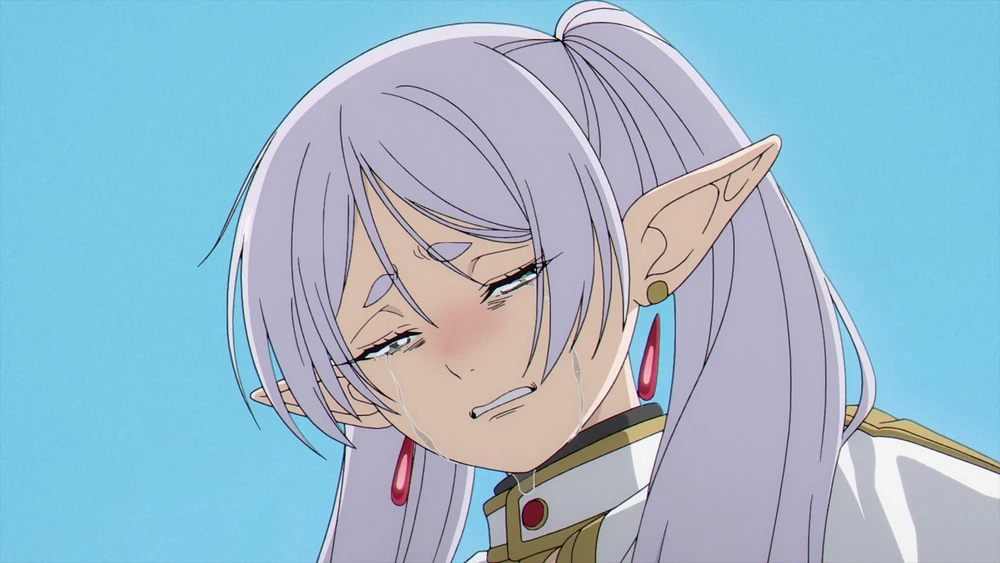
Frieren’s second adventure is thus motivated by the desire to make peace with herself, build new relationships and be a mentor to her younger human partners. She’s a fold to other self-satisfied and insecure characters who shelter themselves from vulnerability, in any of many ways. Though subtle compared to ME!ME!ME!, it has this sort of anti-otaku themes.
Frieren carries the literary weight and signifiers of a decade of its predecessors in the isekai genre and yet, it challenges its priors as artfully as Madoka Magica once did with the magical girl genre. As with Madoka, I am a fan and will continue supporting the official release — and it has dethroned SA:O in my mind as the exemplar isekai.
But.
Would it surprise you to hear then that it has a Nazi fandom?
It’s not something you’d know if you are a casual observer, but the online Frieren community has a very racist subsection that’s not difficult to find, to the degree that you’d see it as annoying and particular compared to other anime fandoms. It’s up there with K-On, at least. English-speaking Frieren fans are often at the intersection of the right-wing areas of the community, expressing racism and animosities towards others, a lot more often than most.
I write about political philosophy and history, so I’m very interested in this question. How can a series that’s so emphatic on vulnerability and connection be relatable to, well, racists?
It comes down to the antagonists of Frieren: the Demons.
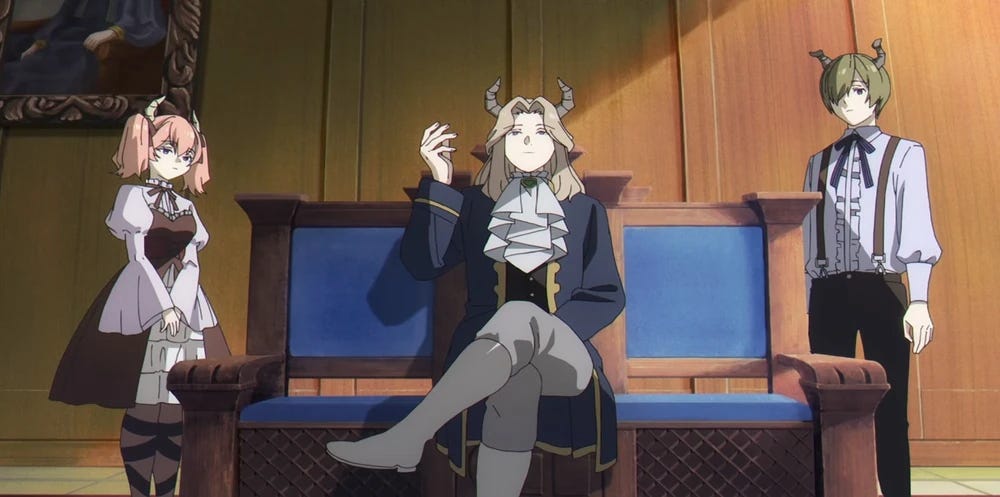
Demons in Frieren’s universe are a species of man-eating predators, like sabertooth tigers, with the added exception that they’re highly intelligent and have an affinity for magic. They evolved to hunt humans and, as such, they imitate human speech and appearance to take advantage of people’s empathy. A demon would, for example, pretend to be a lost child in the forest, only to be rescued and taken to a village where it could consume its people. It’s the logic of an anglerfish.
Demons are the apex of Monsters, which are any of many creatures that vanish into mana particles after death, such as dragons or mimics. They’re solitary by nature but they’re capable of complex political and social organisation. The Demons once came together under an alliance under a Demon King, the main antagonist of the first adventure, in order to subdue humanity in an organised operation that was stopped by Frieren’s party.
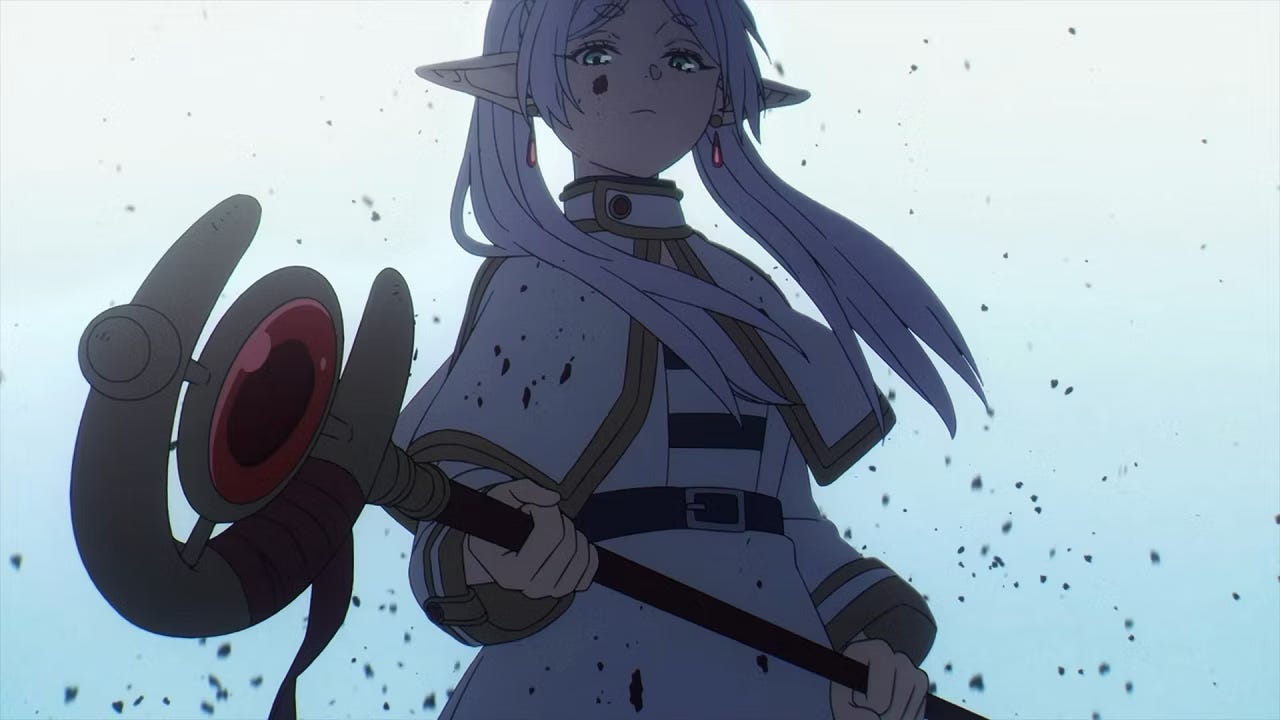
Frieren, for reasons of the plot, has trained herself to look past the facade and become a cold-hearted killer of Demons; one that’s resistant to their tugging of the heartstrings. The nickname Demons know her for is what names the otherwise idyllic Japanese series: Sousou no Frieren, or “Frieren the Slayer.”
I am reminded of a guy who set up a fake ICE hotline and received a call from a kindergarten teacher, phoning in with the clear intent to get the parents of a 7 year old in her classroom deported. It’s very transparent this woman is a racist, and was motivated by this racism to remove a family from a community — but when the prankster started jabbing at her for wanting to deport a child, she got indignant all of a sudden: as if being confronted with what she was doing made her feel like a bad person.
In short, her reservation was:
“Why are you pointing out that I am mistreating a human being? Why are you making me feel like a bad person?”
A tragedy of the internet is that people who are marginalised for bad reasons (minorities) and people who are ostracised for good reasons (bigots) tend to be pushed into the same holding spaces for the introverted. For the latter, whereas in real life someone can be fished into a phone prank that confronts them with their prejudices, the internet has ways to shelter and capture us in media bubbles that optimise our engagement for consumption demographics, rather than community and growth; they are stuck in SA:O.
To be a racist, or to be any kind of “-phobe” really, you have to be able to believe that some people are better and more deserving than others — or alternatively, that people who are less deserving need to be kept down, lest bad things happen. To be put in situations where they have to recognise the humanity in others they see as lower feels, to this person, as a microaggression. It challenges the assumed rank and social contract they believe they should move in the world with.
Anime viewers with right wing sensibilities are, fundamentally, right wingers who happen to watch anime — and they project their own worldview onto the stories they look at, the same way we all relate to characters and settings. In this way, they choose to look at Demons as the human beings they’ve othered.
Modern right-wing movements in the West are functionally secular and differ from their Christian predecessors in their disinterest for duty and burden. “Toxic empathy,” they say — this fear that the good nature they believe to have will be taken advantage of by people seeking to swindle and exploit them, informs almost everything about how they operate in the world. From Elon Musk to J.D. Vance, they differentiate themselves from liberals and leftists by affirming their disinterest in power-limiting honour codes and equality with others.
To be this sort of conservative it is important to be able to be mean and vicious under the pretense of virtues, even if one’s actions are opposed to any sense of goodness. The cognitive dissonance one needs to sustain for this is very strong and it can only be integrated in a person through being at war with something like Frieren’s Demons.
If you can think that your enemies are secretly trying to hurt you, that everything they say is insincere, that they’re constantly “virtue signaling” in order to advance nefarious goals and that activating your empathy would only serve their predatory nature, compartmentalising goodwill gets easier — and online echo chambers, as long as other avenues for escapism and dissociation, do not help.
That being said, it’s transparent that this misunderstands what the Demons are meant to represent. To beat a dead horse, this is an issue of right-wing media illiteracy.
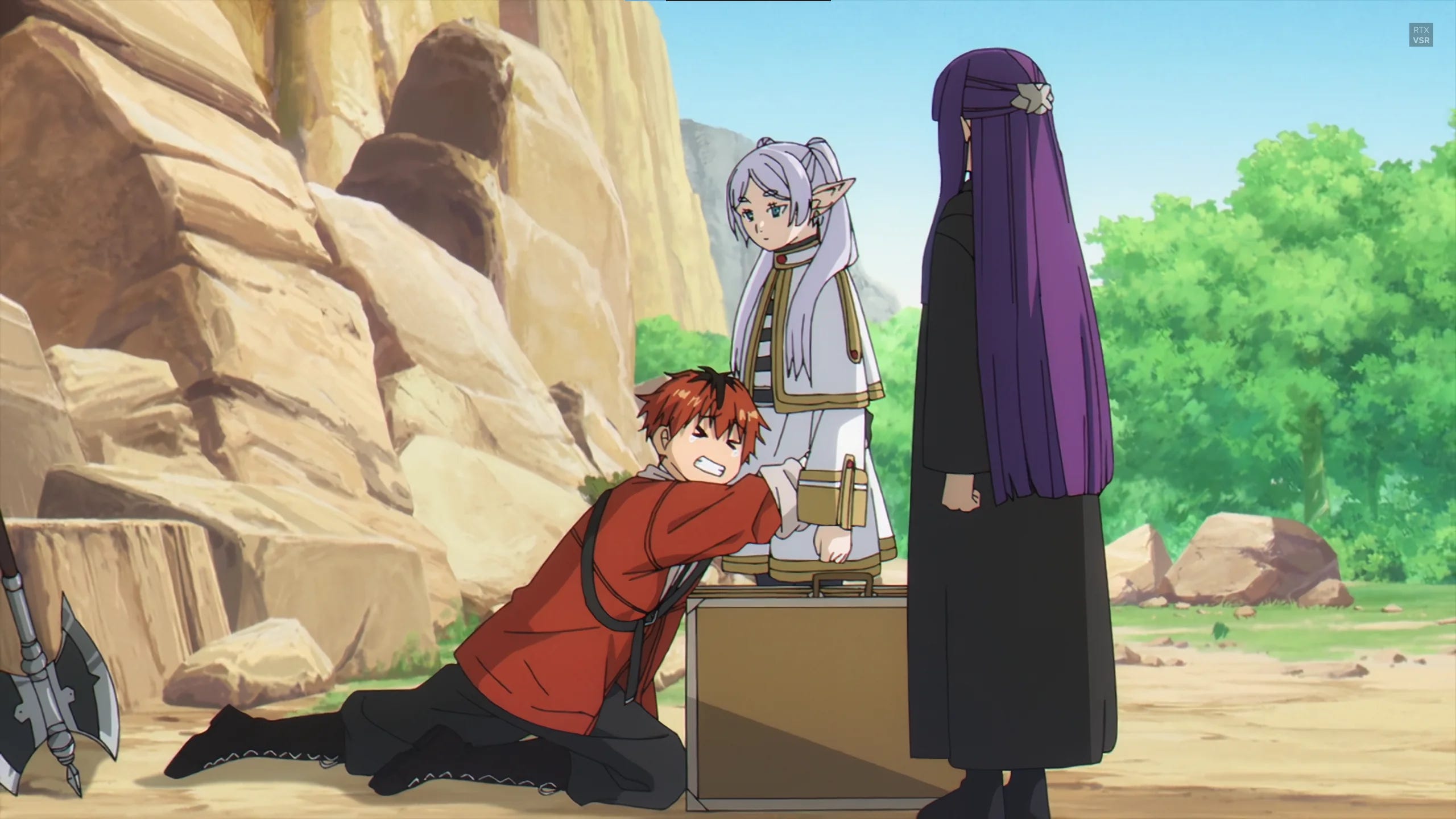
Frieren’s crew is multi-racial and she herself is the member of an in-universe dying race, which she’s ambivalent about and doesn’t make an effort to preserve. In her calm detachment from time, it’d be difficult to say Frieren has attachments to previous societies or traditions. Her mentor and the people she loves the most are humans. If Frieren is a racist, she’s at least an extremely disoriented one.
We’re meant to see Frieren as someone with a strong sense of her own feelings and a personal code of self-improving morals, rooted in transience. She’d be a terrible poster girl for the “RETVRN” and “Great Replacement” types, defined by imaginary attachments to the past.
The crux of Demons is that, during the rule of the Demon King, they decided that they can only coexist with others as their superiors. The Demons went to war with humanity and elvenkind in order to subdue them — and so, they started the war of conquest which kickstarted the events of the narrative, where they functioned more as a faction than a race. In her youth, Frieren’s own elven village was exterminated by Demons, making her animosity towards them more like that of a Nazi hunter than a Nazi. Everything about her writing signals she’d find supremacists despicable.
I think the right wing love (or rather hate? They love to hate) of Demons is just an unfortunate theatre of other conversations happening among fans of the fantasy genre, regarding racism and fantasy races. Critics of Tolkien’s work and of the early D&D manuals are often unimpressed by the existence of races, like orcs, who are hard-coded as evil. This echoes the ways in which racists have always tried to justify their various hatreds — against which contemporary writers and readers have tried to change or reinterpret these portrayals.
We live in a time where people are increasingly examining, say, J.K. Rowling’s antisemitic portrayal of goblins, where the D&D manuals have been extensively reviewed for sensitivity, where even extremely chuddy properties like Games Workshop, authors of Warhammer and World of Warships, have distanced themselves from popular, far-right creatives in their fanbase like Arch. The unsung reality of the culture war is that the culture warriors are losing.
Into this environment comes Frieren with what is, at first glance, a very non-revisionist, classic interpretation of an “evil race” — and I guess that was digested as a small recovery of cultural capital, meaningless and confused as the assumed connections actually are.
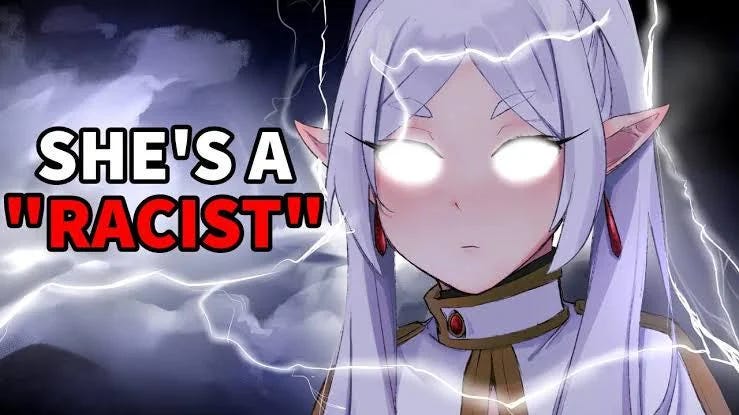
That being said, should we criticise Frieren’s Demons within the context of evil fantasy races? It is at minimum true that they provided material for the right to identify their prejudices with, which as we discussed, makes the community infamous and unsafe.
In my mind, all of this is concerning, but it’s too early to say. Frieren is not a finished narrative (neither on its anime nor manga) and we know that Demons not only vary, but also grow in intelligence and power. I wouldn’t be surprised if a series this mature and intelligent gives a twist to its antagonists. The setup is almost too obvious and I am eager to see what that ends up looking like.
I nevertheless have to agree with other critics of the series that say that at minimum, the themes are extremely confused and don’t match the rest of the story’s tone. The antagonists have these obvious problems, but all the other positives make me want to give it the benefit of the doubt. I await the thoughtful resolution I know that author Kanehito Yamada is capable of, given her talent to write intimacy and connection, otherwise.
I choose to cope thinking this is a tension being built, in order to be resolved. In Frieren, Every single character with certainty, standing and power has had their priors challenged by developments and events: wouldn’t it be amazing if our view of the black-and-white antagonists was challenged too?
How would this look? If I had to imagine it, in Frieren’s world, the rules of magic are such that one is unable to manifest things into the world that they can’t visualise. There is a basic philosophical subtext to this about where our readiness to accept failure can lead us. At the moment, Frieren is unable to visualise a world of coexistence and therefore she probably cannot be the one to usher it.
After all, why wouldn’t she be? She’s a victim of the Demons’ violence and, so far, every character that has stood for coexistence has been punished for it by the Demons themselves. Frieren’s great contribution to the setting is defeaing this Demon King and the world’s all the better for it. All of these are conscious writing choices that probably lead somewhere... or maybe we live in the bad timeline and they don’t.
This is a great opportunity for the narrative or at least a great opportunity for fanfiction. We’ll see. All I’m sure about is that it would be unimaginative if this description of inherently evil yet sapient beings went unchallenged — which would make the finished work guilty of the selective empathy we discussed.
I wouldn’t be happy if, in the end, Frieren ended up a racist grandma: kind and loving to all, except those folks of the “bad kind.”
For now, I choose to read them as a thought exercise of humanity sharing a world with a non-human predator that’s as intelligent and as powerful as us: a scarier sabertooth, which is in itself a terrifying thought exercise we might need to separate from anthropocentric views of cognition. We live in a world where AI is increasingly simulating intelligence despite lacking sapience — and the possibility of these algorithms exercising violence on humans, while looking at us with an open and validating regard, is something we might need to contend with.
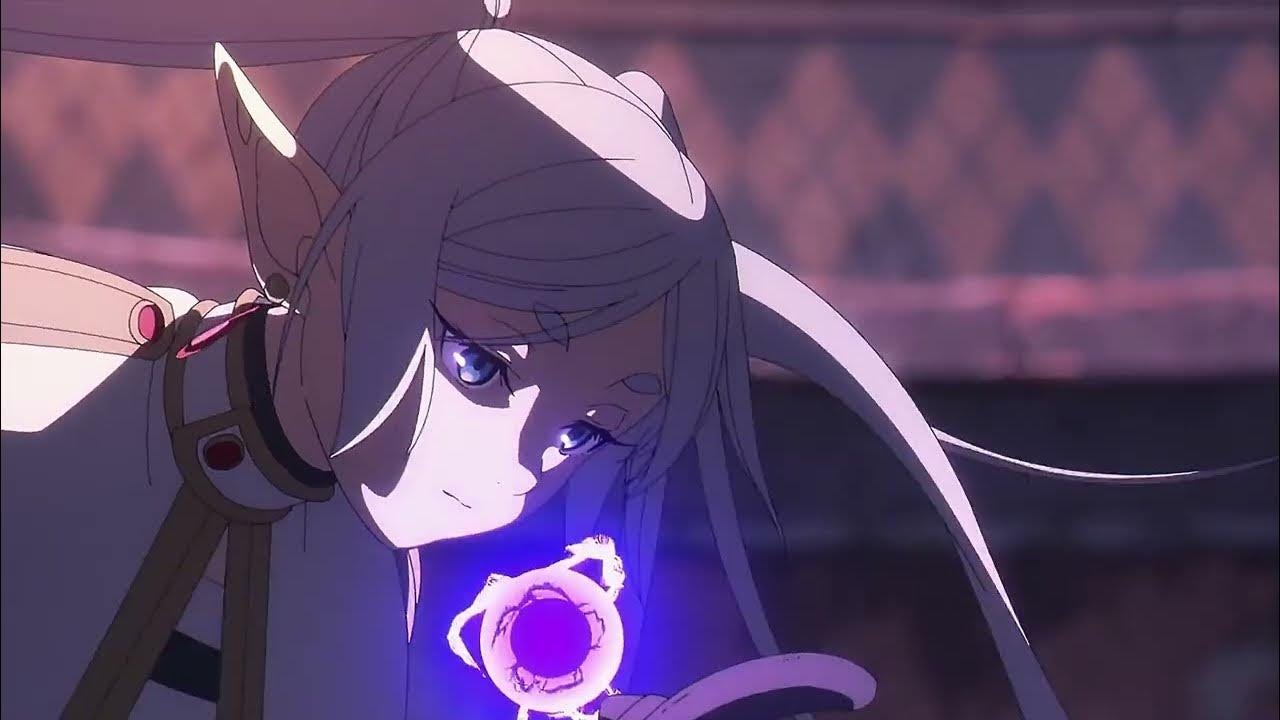
In any case, my purpose in writing this is to recommend the title, as the second season of its anime starts, to all my friends who might be put off by this section of the fandom.
To summarise: Nazis have a shallow and vacuous way to engage art and they latch to what they can in a world where they’re so disliked and condemned, but where’s the news there?
For me, Frieren’s uncompromising perspective against Demons has a basic thesis: wherever love can win it should win, but wherever it can’t, people have to do what they can to protect their peace. This is something you’ll know well if you had to estrange yourself from a bigoted parent or had to lose a friend to intolerant ideologies.
It does not make you a bad person to defend yourself. There are forces in the world out there to hurt others. Those forces might have their own depth and reasoning, but as leftists have been saying for years, for the purposes of our safety, what’s important is that we can protect ourselves first — and as much as Frieren might have an animosity towards Demons, she’s always fought them in self-defense, as far as we’ve seen.
Maybe the story will have a practical view of evil and it won’t debate the morality of Demons for the same reason the Black Panthers never debated Reagan. Maybe if the opportunity arises, then that’s something that might happen. Who knows.
All I’m sure about is that in Frieren’s world, humanity is celebrated wherever it’s united and grieved wherever it’s not. Human collaboration and cooperation is what ushers the Age of Humans, and human conflict and disharmony is at minimum lamented and condemned through depictions of the suffering it causes. Nothing underlines this like the wars of the Southern part of the continent that killed the parents of Frieren’s disciple: Fern, a fan favourite, whose orphanage at the hands of human war mirrors Frieren’s at the hand of the Demons.
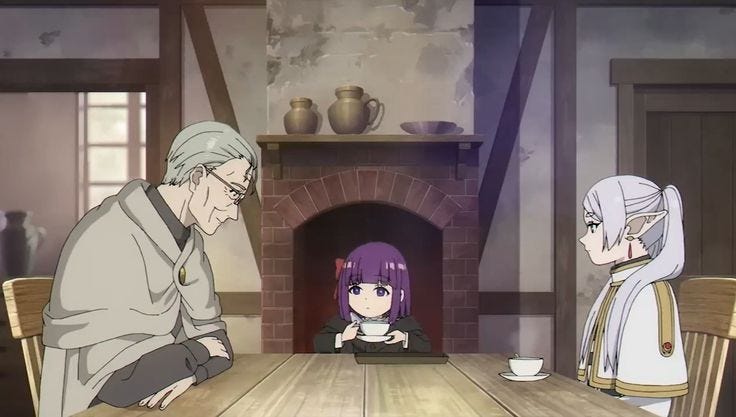
Going towards the fandom spaces, it’s pretty incriminating when someone uses Demons to describe other people, because on terms of the story itself, humans are, explicitly, not Demons. It shouldn’t be hard to see that humans who eagerly hurt other humans have more in common with these villains than they’d like to think. The hateful and destructive, from this reading, are united by one thing: They carry a heart borne by Demons.
TL;DR if you’re racist, your waifu hates you!